At the currently ongoing Special Exhibition "Kiteretsu Daihyakka" × "Doraemon",
you can view many original artworks up close.
Among them, if you look closely at an original artwork of "Doraemon", you'll notice...
that the body of Doraemon, drawn with a black pen,
is colored with blue pencils!!
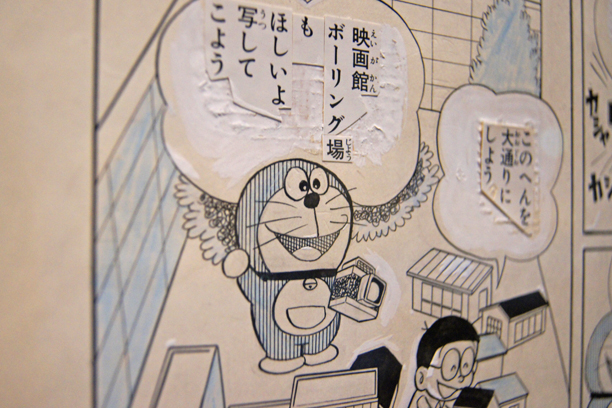
What is this?
It's not because "Doraemon's body is blue!"
...That's not the reason at all.
As proof, "Korosuke" from "Kiteretsu Daihyakka" is
also colored blue! Look!
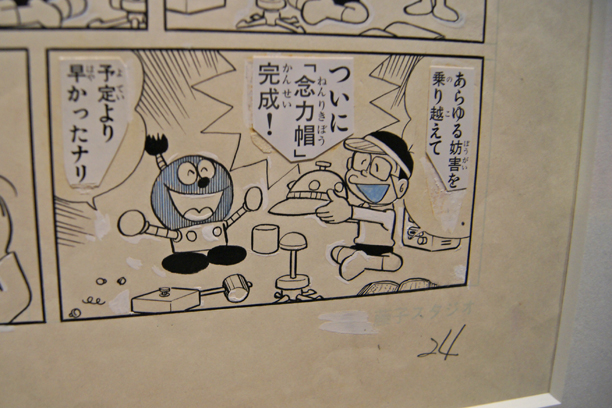
So then, why?
To tell you the truth, this blue.
When printing the original artwork,
it was added as a color with the instruction
"Please apply the 'amikake' treatment at the printing company".
("amikake" = a method of expressing shading with a single color using dots and lines)
In reality, it looks like this when printed.
"amikake" is applied to Doraemon and the background block fence too!
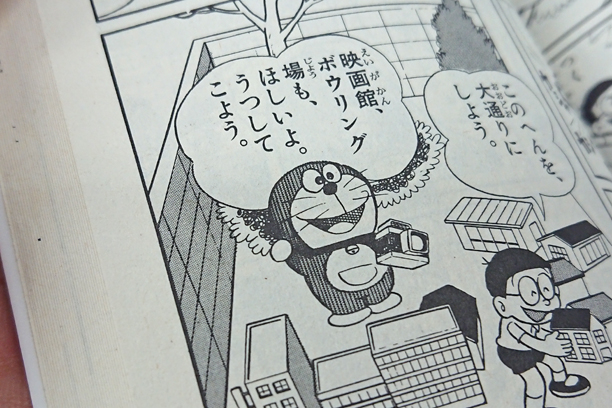
Finding the differences like this with the magazine or book
is also one of the joys of viewing original artworks!
Well then.
At the currently ongoing Special Exhibition "Kiteretsu Daihyakka" × "Doraemon",
you can view many original artworks up close.
Among them, if you look closely at an original artwork of "Doraemon", you'll notice...
that the body of Doraemon, drawn with a black pen,
is colored with blue pencils!!
What is this?
It's not because "Doraemon's body is blue!"
...That's not the reason at all.
As proof, "Korosuke" from "Kiteretsu Daihyakka" is
also colored blue! Look!
So then, why?
To tell you the truth, this blue.
When printing the original artwork,
it was added as a color with the instruction
"Please apply the 'amikake' treatment at the printing company".
("amikake" = a method of expressing shading with a single color using dots and lines)
In reality, it looks like this when printed.
"amikake" is applied to Doraemon and the background block fence too!
Finding the differences like this with the magazine or book
is also one of the joys of viewing original artworks!
Well then.
